
The amount allocated for 2019-20 is 11 per cent higher compared to Rs 55,000 crore allocated for the year 2018-19.

The total allocation to the defence sector is 12.9 per cent of the total budget of the government of India for the financial year 2024-25.

Government's objective is to bring down the cost of cultivation through efficient use of fertilisers and agro chemicals, and increase in realisation. It is, thus, planning to connect 200 agricultural mandis with electronic National Agricultural Mandis this year and 225 next year, to enable farmers to sell their produce hassle-free online.

Strategic divestment of select public sector undertakings will remain a priority area, she said.

Nirmala Sitharaman has designed the revenue mix in such a way that while Centre's share in taxes would grow a massive 25 per cent, states' share would grow a dismal 6 per cent.

This will violate the time-honoured convention that a government elected for a five-year tenure presents only five full Budgets, but the NDA government will no doubt present it as yet another initiative of Mr Modi.

The outlay for defence sector almost remained unchanged compared to what was allocated in the interim budget on February 1.

In this year's budget, Finance Minister Nirmala Sitharaman hiked tax on petrol and diesel, raised import duty on gold, levied additional surcharge on super rich and brought a tax on high value cash withdrawals as she sought to spur growth with reduction in corporate tax and sops to housing sector, startups and electric vehicles.
The people of the nation co-operated and patiently waited for the government's promised "ache din", and now they want their just rewards, says Adhil Shetty.

'Are all roads in India privatised? Are governments not playing a role in airports or ports? If they (private players) want to set up lines for a specific requirement, I see no reason to object. It will expand the opportunity and passengers will also benefit.'

Elections are not won or lost by expounding on such macro-economic matters. For the aam admi, what matters in manifestos are promises that will improve their quality of life, notes Vinayak Chatterjee.

The bias for the BSE benchmark index, technical charts suggest, is likely to remain bullish as long as the index holds above 75,600 levels for the rest of the year.

Agriculture credit is likely to exceed the target of Rs 7,00,000 crore while farm exports are expected to increase to over $45 billion in the current fiscal, Finance Minister P Chidambaram said today.

She posed for the traditional 'briefcase' picture outside her office along with her team of officials before heading to meet the President. She, however, was holding a tablet instead of a briefcase to present the Budget in a digital format.
Hussain said the new government had inherited an "empty treasury" while the prices of oil were shooting up.

While Andhra Pradesh is expected to receive Rs 15,000 crore to Rs 20,000 crore, Bihar is likely to get Rs 5,000 crore to Rs 10,000 crore in FY25.

India's current account deficit (CAD) will be contained at USD 45 billion this financial year, well below the record high level of 2012-13, Finance Minister P Chidambaram said on Monday.

The supplementary demands for grants include a gross additional spending of over Rs 2 lakh crore, which would be matched by savings of over Rs 1.21 lakh crore.

The special package assistance would be used to augment irrigation structures in drought-prone areas to address the agrarian distress and drinking water crisis.

Investors should view the increase in the LTCG tax rate in conjunction with the increase in capital gains exemption from Rs 1 lakh to Rs 1.25 lakh, which will provide some relief.

The dates of general elections in 2019 and the presentation of the final Budget of the Modi government are so far removed from each other that Jaitley is not under any pressure to present a populist Budget. Instead, he could well unveil an array of schemes and proposals that he believes are necessary for the economy, even if a few of them could be unpopular, says A K Bhattacharya.

The government also announced that healthcare cover under the Ayushman Bharat insurance scheme will be extended to all ASHA and anganwadi workers and helpers.
Pradhan Mantri Jan Dhan Yojana and Make in India -- are not covered here.

Concerned by GDP slowdown and unrealistic tax targets, the economists urged Finance Minister Nirmala Sitharaman to implement long-term structural steps like land and labour reforms. Warning against any off-Budget financing the economists said the government should prepare a statement of intent for its social, rural and welfare sector expenditure.

'The Budget needs to focus more on social welfare schemes.'
The Rajya Sabha is slated for a 12-hour discussion on the Motion of Thanks to the President's address to the joint session of the two Houses of Parliament, which also includes the reply by the prime minister, which is likely next Tuesday.

Converting what was supposed to be an interim budget or a vote on account into an almost full-fledged budget announcement in the Lok Sabha, Finance Minister Piyush Goyal proposed an array of incentives for both middle-class and farmers, whose disenchantment was said to have cost the BJP dearly in recent assembly elections.

Stocks might hit new highs even before B-Day.

The divestment target remaining unchanged, from the 2019-20 interim Budget, this year means the Centre will now have to depend on non-tax revenue sources like dividends from the RBI, PSBs and PSUs, as there are real concerns of a tax revenue shortfall. The fiscal deficit target of 3.4% of GDP for 2019-20 is likely to be retained as well.

Fresh plans of privatisation or divestment in central public sector enterprises and public sector banks might take a back seat this financial year because these may require a large consensus among coalition partners.
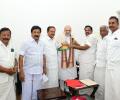
EPS has had its way on most things, alliance-wise. A week earlier, he reiterated that he would not re-admit OPS and Sasikala Natarajan back in the party. It was a message not just to detractors in the AIADMK. It was even more so for the BJP leadership in Delhi. Even more important for the AIADMK was their demand for accepting EPS as the chief ministerial candidate of any alliance that the party would form, observes N Sathiya Moorthy.

CBDT has been given a collection target of Rs 5.69 trillion in personal income tax in the fiscal year 2019-20 - 19.2 per cent more than the Rs 4.77-crore collection in the previous year.

Sitharaman added that no Union finance minister can play with the Finance Commission's recommendations.

Several critics including some rating agencies have doubted prospects of meeting this ambitious fiscal deficit target.

'Rather than taking a very short-term view on the markets, equity investing should be premised on longer term growth opportunities.'
Budget-makers in North Block are looking to maintain this fiscal status quo, in spite of tax revenues nowhere close to where the government wants and in spite of possible higher expenditure commitments.

'... there are challenges to overcome and the country needs money for that.'
The Union government is projected to share about 32 per cent of central taxes with states during the financial year 2024-25 against the 15th Finance Commission's recommendation of 41 per cent. The Revised Estimates (RE) for FY24, too, show a similar share of states in the central taxes at 32 per cent. In absolute terms, however, there has been an increase in the amount devolved to states compared to the Budget Estimates (BE) for FY24 at Rs 11 trillion.

Indian Railways has managed to improve its freight volumes each year since the pandemic. However, its inability to add new industries and goods will pose a challenge for the national transporter in the wake of it setting an ambitious target of 45 per cent share in the national logistics by 2030. According to officials, the ministry of railways achieved 114 million tonnes (mt) of miscellaneous goods (classified as balance and other goods) in 2023-24.

'On the tax front, most of the Budget proposals are sensible'.
